Follow a concern at the school entrance.
A possible weapon-like object needs urgent review. Keep the source, entrance location and response responsibility together.
Authored site model · virtual camera views
Before the entrance.
The fixed elevated camera covers the forecourt and glass entrance. The fictional subject approaches from the left.
Perception
1 of 8 proposed contributions
Inspect the low-carried object’s available shape and source location as a possible firearm. Keep classification uncertainty explicit; the clear branch supplies an authored confirmation assumption.
A response is still work in progress
Follow each recipient, the separate human instruction and the questions still open.
Coordinate the school emergency response
The case is developingShare the source frame, camera, entrance location and case updates across the three routes already authorised by this example policy. Track each recipient independently; no real notification is sent.
Police / emergency services
Receive the entrance location, visible-threat evidence and continuing case updates.
Site security
Review the source and coordinate the site security response.
School emergency response lead
Start the configured emergency procedures and acknowledge the case.
Keep the work visible.
The next steps stay with the case.
The additional instruction stays with its responsible lead. The emergency routes proceed under their configured permissions; missing acknowledgements and continued source monitoring remain active work.
A separate decision, where site rules require it
Authorise an additional protective instruction
Designated school response lead
Only an additional instruction specifically reserved by the example site policy stays held. It is not permission to notify police, emergency services or security, and cannot block emergency procedures already required by that policy.
The configured response routes remain independent of this separate decision.
This is an authored demonstration. No real notification, acknowledgement or physical action occurs. Recipient acknowledgement and verified completion remain separate.
A concern needs the right people, quickly.
Separate the observable source from what remains uncertain.
Know the place
Connect the public approach, the school rule and the people already authorised to respond.
Give the work an owner
Inspect the source, prepare the task and keep a person responsible for the result.
Make the next step useful
Less time reconstructing the same event across separate channels.
Explore another responsibility.
Restricted-access review; staff-reported assistance; unattended item review
Connect the camera moment with the relevant access event and the site rule.
Restricted-access review
An entrance event needs checking.
- Permitted work
- Assign a review to designated school security.
- What completion needs
- Record what the review establishes and whether further work remains.
Example inputs are available. Preview the permitted work.
Work and review history
Illustrative workflow. Access-event correlation requires a supported integration.
Go deeper into the case.
Why this matters, and how context changes it
Give people time
to respond.
A school’s cameras can cover an approach long before a concern reaches a classroom. This case starts outside, where an observable weapon would first become visible in a supported camera view. It does not imply detection of a concealed object or guarantee recognition before entry.
The clear threat branch routes the evidence and entrance location to police or emergency services, school security and the configured emergency workflow in parallel. Urgent actions already permitted by the site policy do not wait for a generic approval button. A separate instruction appears only where the site’s rules require a person’s decision.
An unresolved object still calls for urgent verification. An interior observation remains relevant when a concern first becomes visible inside; it is not a substitute for this exterior approach story.
Start at the first visible warning.
A fixed exterior view covers the approach and entrance. The model illustrates the location and coverage without claiming calibrated dimensions.
Connect views without inventing evidence.
The native viewer’s two cameras show the same authored site. Independent source-camera continuity must come from coherent supplied footage, not a second model angle.
Emergency routes run in parallel.
The example clear-threat policy routes to police or emergency services, school security and configured emergency procedures. Optional human decisions do not block these routes.
What the evidence can establish
Possible firearm at the approach
The source shows a small low-carried dark object beside the hand. Its shape and location support a possible-firearm review, not definitive classification. Clear and uncertain branches are authored alternatives; illustrative confidence is not a measured classifier result.
One approach in fixed coverage
The same person moves towards the entrance and stops outside, well short of the doors. No aiming, firing or entry is shown. The crop and native site views share an authored connection; they are not independent cameras.
Entrance, occupied areas and response routes
The authored site plan relates the observation to the entrance, nearby pupils and the configured security and emergency contacts.
Emergency routes already authorised
The example site policy permits coordinated police/emergency notification, site-security notification and configured emergency procedures. An additional policy-required instruction is a separate decision.
Source basis
The reviewed generated source uses a fixed elevated camera across a school forecourt. The fictional adult student moves left to right towards the entrance and stops outside, well short of the doors. The low-carried dark object is small in the source; the first observation is a possible firearm. The clear and uncertain evidence branches are authored alternatives, not calibrated classification results.
The opening advances from 0 to 5 s, interpretation holds the reviewed 5 s frame, and follow-up uses 5–5.8 s. A labelled crop and authored outline refer to that frozen source frame only. The source remains outside the entrance. The native cameras provide virtual views of the authored site.
Virtual model views are authored interpretations. They do not add independent source evidence or measured site geometry. Actual product claims require recorded product evidence and evaluation.
Reviewed school observation frame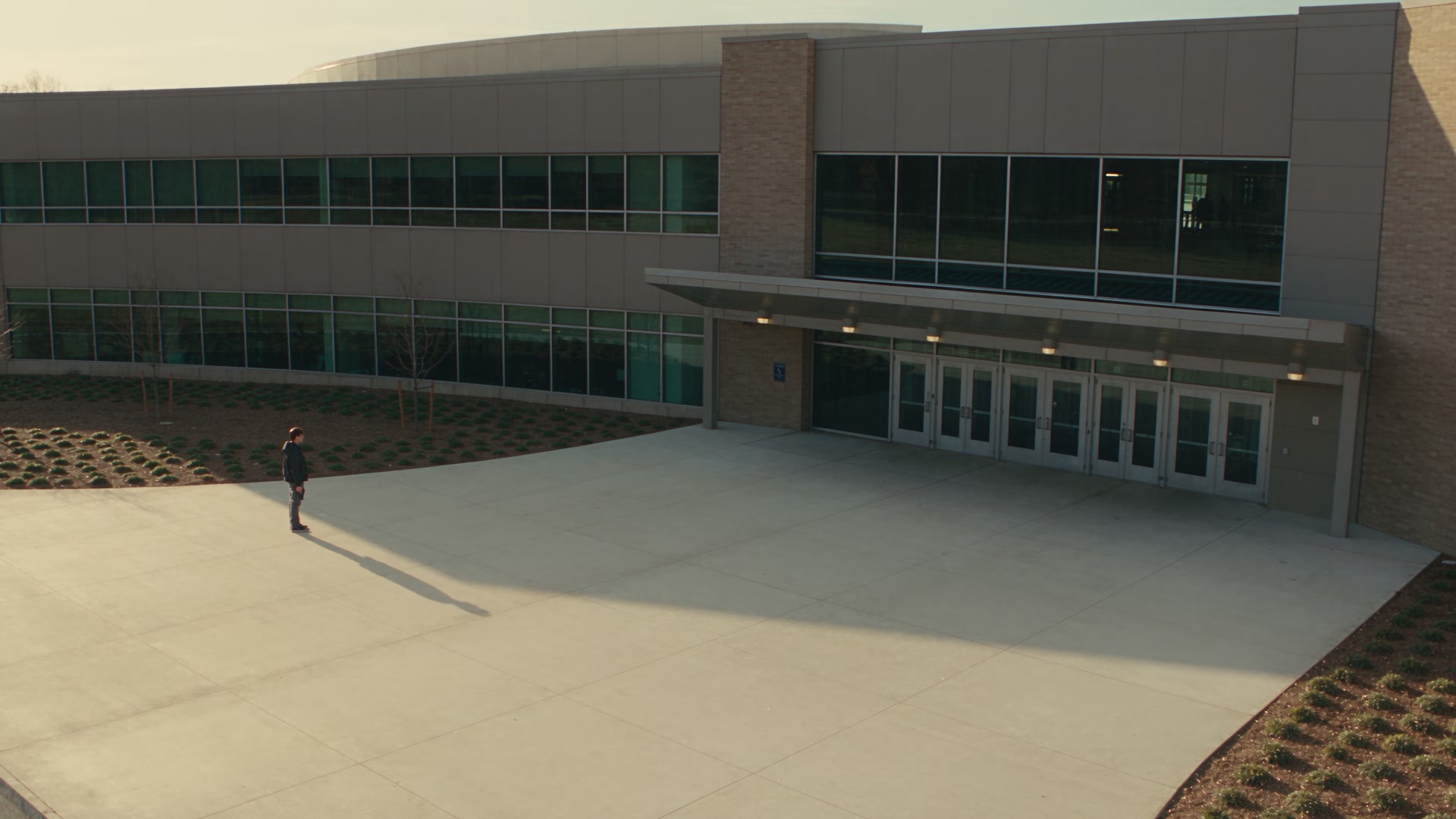
What a useful pilot would evaluate
Evaluate whether the relevant warning reaches the correct recipients with its source and location intact, whether they acknowledge it, and whether the subsequent work is actually verified.
| Pilot question | What the pilot records | What the team evaluates |
|---|---|---|
| Relevant observations | Compare selected scenarios with an independently reviewed reference set, including ambiguous objects. | Inspect missed cases and unnecessary alerts, not only successful examples. |
| Staff understanding | Ask duty staff to identify the location, source evidence and responsible lead from the case. | Check whether the handoff supports a correct interpretation. |
| Authority and acknowledgement | Record which notification was permitted, who decided the wider instruction and whether staff acknowledged it. | Treat notification, authorisation and outcome as separate events. |
| Boundaries | Review access to pupil evidence, retention and the agreed monitoring purpose with the institution. | Evaluate the workflow within the school’s stated responsibilities. |
These are proposed evaluation questions, not published pilot outcomes or benchmark results.
Inspect the assessment and case trace
The clear branch shows a visible weapon near the school entrance. The configured emergency response proceeds without waiting for an additional staff decision.
These are authored case states. Review priority, evidence quality and permission are different questions.
- SIMULATEDThe place is established
Fictional school exterior approach, entrance and adjoining teaching areas
Build a school pilot around a real need.
Agree the source conditions, responsible team, permitted actions and evidence needed to confirm a useful result.
Discuss a school pilot