Bring a boundary review to the control room.
A worker approaches a configured area while the responsible team is elsewhere. Prepare a check with the source and the rule.
Authored fixed CCTV · 0.0 s
An operating area, observed.
A fixed camera covers a configured work zone. The responsible manager is elsewhere.
Perception
1 of 8 proposed contributions
Resolve the worker, visible approach and physical yellow machine boundary in the fixed CCTV view.
Keep the inspection open
An acknowledgement records receipt. It leaves the inspection finding and the later site condition to be checked.
Notify the remote control room and assign a review
The case is developingAttach the camera, physical boundary, configured warning buffer, approach clip and next monitoring task to one case. The recipients need not witness the approach themselves. The alert describes a preventive review, not a confirmed exclusion-zone breach; acknowledgement does not prove safe clearance.
Remote control-room operator
Review the camera and event clip, acknowledge receipt and coordinate the next check.
Responsible operations manager
Own the preventive review, monitor the next movement and request a separately verified safe state.
Keep the work visible.
The next steps stay with the case.
The remote team receives the approach evidence and preventive review task while the additional instruction remains held. Track acknowledgement and the next movement separately. The worker’s observed position outside the boundary does not close the continuing monitoring task.
A separate decision, where site rules require it
Authorise an additional operating instruction
Remote operations manager
Only an operating change reserved by the example site policy needs this separate decision. CCTV reporting, task assignment and acknowledgement proceed independently. No machinery stop or interlock is connected or asserted.
The configured response routes remain independent of this separate decision.
This is an authored demonstration. No real notification, acknowledgement or physical action occurs. Recipient acknowledgement and verified completion remain separate.
An observation on the floor must reach its owner.
A camera view cannot explain the active boundary, operating rule and control-room responsibility on its own.
Know the place
Keep the physical boundary separate from an early review buffer, then prepare the appropriate check.
Give the work an owner
Inspect the source, prepare the task and keep a person responsible for the result.
Make the next step useful
A preventive review with a clear owner and a result that can be inspected.
Explore another responsibility.
Exact-component quality review; blocked-route inspection; inventory reconciliation
Compare a configured product feature or label with an agreed inspection definition.
Defined defect checks
A component has a visible feature selected for inspection.
- Permitted work
- Send the quality team the relevant image and inspection task.
- What completion needs
- Record the team’s finding and disposition before calling the item accepted or rejected.
Example inputs are available. Preview the permitted work.
Work and review history
Illustrative quality workflow. Validate each product, defect and production environment.
Go deeper into the case.
Why this matters, and how context changes it
Notice the event.
Coordinate the work.
An operating area should not depend on a supervisor already witnessing every interaction. A configured zone, movement and proximity give an unattended camera observation its site-specific meaning.
The fixed source shows a worker approaching the machine’s painted yellow exclusion boundary and stopping outside it. An authored early-warning buffer, separate from that physical boundary, supports a preventive report to the remote control room. Possible later entry belongs to the forecast; no exclusion-zone breach is established.
The manager acknowledges the case and assigns an inspection. Continued observation and a later verification remain separate. No nearby hand signal, automatic machine stop or interlock is used as the resolution.
Keep the two boundaries distinct.
The source’s painted yellow boundary is the physical exclusion zone. The native early-warning buffer sits outside it. The worker approaches and stops outside the exclusion boundary; potential entry remains a forecast.
Separate the event from the forecast.
The case preserves what was observed and what might happen next. A predicted conflict is not a confirmed collision, and no machine stop is implied.
Reach the control room.
The event report carries camera, zone, evidence and assigned work to a manager who is not beside the hazard. Acknowledgement and clearance remain separate.
What the evidence can establish
Worker approaching the machine boundary
CCTV locates the visible worker and the physical yellow machine boundary. The configured early-warning buffer is a separate site rule outside that boundary, not evidence of a prohibited-area breach.
Preventive approach sequence
Connect the worker’s approach through the configured warning buffer while preserving the observed position outside the machine boundary. Possible later entry belongs to the forecast.
Buffer rule and remote ownership
The authored configuration distinguishes the exclusion boundary from the early-warning buffer and identifies the camera, preventive review rule and remote owner.
Reporting and permitted coordination
The example policy permits a remote evidence-linked notice and review task. A local warning may be configured separately; machine control is not assumed.
Source basis
The reviewed generated source uses a fixed elevated CCTV composition. A worker approaches the machine’s yellow boundary and stops outside it. The native early-warning buffer is an authored overlay outside the physical exclusion zone, not a painted marking or a confirmed breach.
The reviewed sequence runs from 0 to 5.8 s of a 6.04 s clip. No supervisor intervention, automatic machine stop or completed clearance is shown. The remote report, assignment and acknowledgement are separate authored coordination work.
Virtual model views are authored interpretations. They do not add independent source evidence or measured site geometry. Actual product claims require recorded product evidence and evaluation.
Reviewed factory observation frame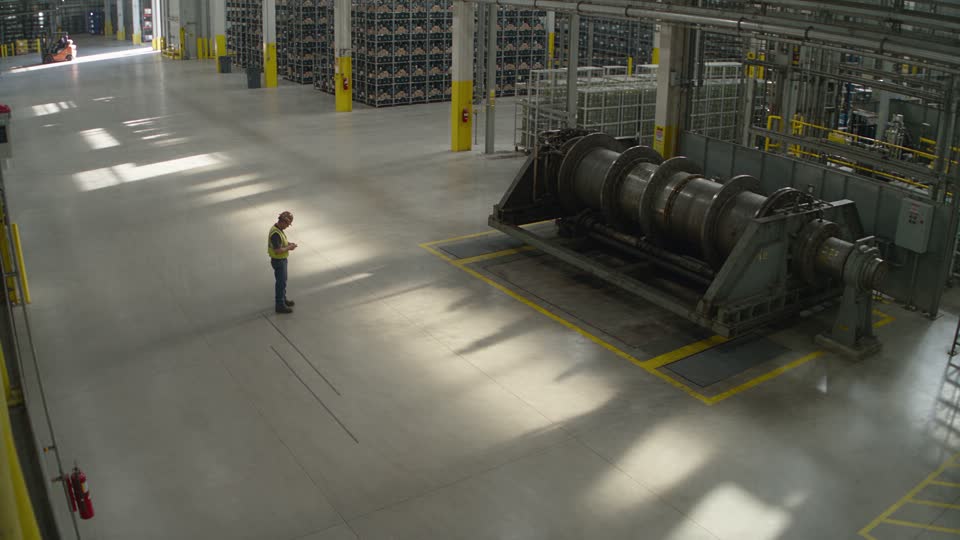
What a useful pilot would evaluate
Evaluate useful unattended-zone observations, the quality of remote handoffs, acknowledgement gaps and verified follow-up. Do not count a delivered report as an incident prevented or an area cleared.
| Pilot question | What the pilot records | What the team evaluates |
|---|---|---|
| Relevant zone events | Compare configured rules and recorded interactions with an independently reviewed reference set. | Inspect missed events, false reports and alternative safe movements. |
| Remote handoff | Review whether the control room receives the camera, zone, evidence, priority and actionable task. | Measure correct interpretation as well as delivery and response delay. |
| Unanswered work | Exercise unavailable recipients, assignment and shift handover. | Check that missing acknowledgement remains visible. |
| Verified follow-up | Record inspection findings and the later zone state separately. | Distinguish acknowledgement from clearance and an observed event from a forecast. |
These are proposed evaluation questions, not published pilot outcomes or benchmark results.
Inspect the assessment and case trace
An approach towards the machine boundary within the configured early-warning buffer warrants preventive review and continued monitoring by the remote team.
These are authored case states. Review priority, evidence quality and permission are different questions.
- SIMULATEDThe place is established
Fictional factory machine boundary and configured early-warning buffer monitored from a remote control room
Bring a real operating boundary into the next evaluation.
Agree the source conditions, responsible team, permitted actions and evidence needed to confirm a useful result.
Discuss an industry pilot